Crochet Chart Symbols: How to Read a Crochet Chart
You found a gorgeous pattern, opened it up, and instead of rows of words there’s a diagram full of ovals, crosses and little T’s. Don’t panic! Crochet charts look intimidating, but they’re actually a picture of your finished stitches, and once you learn about a dozen symbols you can read most of them.
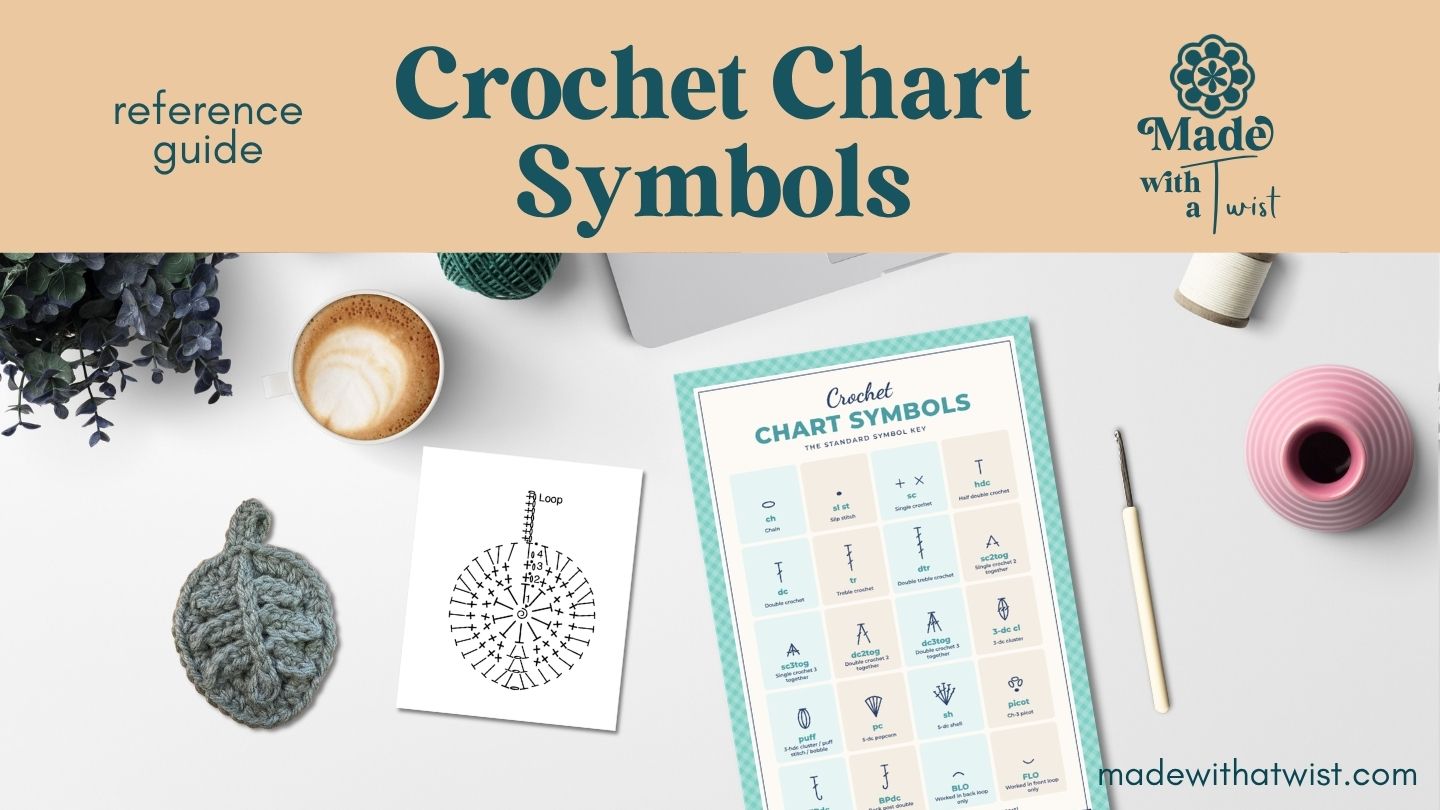
This page has the complete crochet chart symbol key (the standard symbols recognized by the Craft Yarn Council), a few tricks for telling them apart at a glance, and a step-by-step guide to reading crochet charts worked in rows and in rounds.
Jump to a section
- Crochet chart symbol key
- How to tell symbols apart at a glance
- How to read a crochet chart worked in rows
- How to read a crochet chart worked in rounds
- Tips for reading crochet charts
- Crochet chart FAQ
Crochet chart symbol key
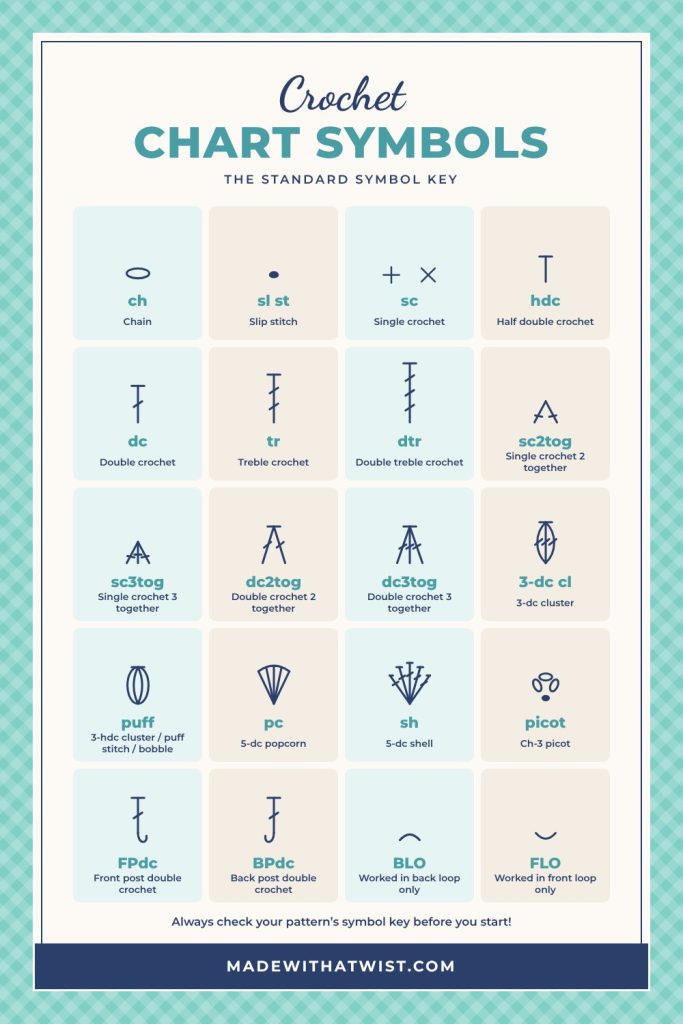
Each symbol is drawn roughly the shape and height of the stitch it stands for. The first four tables are the standard symbols recognized by the Craft Yarn Council, and the last one covers other symbols you’ll see often. Most designers use these, but some add their own, so always check the key on your pattern before you start.
Basic stitches
| Symbol | Stitch | What it looks like |
|---|---|---|
Chainch | A small horizontal oval. | |
Slip stitchsl st | A small filled-in dot or oval. | |
Single crochetsc | A plus sign (+) or an X. Both are standard, so check your pattern’s key. | |
Half double crochethdc | A short T. | |
Double crochetdc | A taller T with one diagonal line across the post. | |
Treble crochettr | An even taller T with two diagonal lines. | |
Double treble crochetdtr | The tallest T, with three diagonal lines. |
Decreases
| Symbol | Stitch | What it looks like |
|---|---|---|
Single crochet 2 togethersc2tog | Two single crochet legs leaning in and joined at the top. | |
Single crochet 3 togethersc3tog | Three single crochet legs joined at the top. | |
Double crochet 2 togetherdc2tog | Two double crochet posts joined under one top bar. | |
Double crochet 3 togetherdc3tog | Three double crochet posts joined under one top bar. |
Clusters, puffs, popcorns, shells and picots
| Symbol | Stitch | What it looks like |
|---|---|---|
3-dc cluster3-dc cl | Three double crochets joined at the top and the bottom, so the shape is closed. | |
3-hdc cluster / puff stitch / bobblepuff | A rounded oval shape with lines inside it, closed at the top. | |
5-dc popcornpc | Five stitches fanning out from one point, closed across the top with a curve. | |
5-dc shellsh | Five double crochets fanning out from one point, open at the top. | |
Ch-3 picotpicot | Three chain ovals in a little loop, closed with a slip stitch dot. |
Post stitches and back and front loops
| Symbol | Stitch | What it looks like |
|---|---|---|
Front post double crochetFPdc | A double crochet with a hook at the bottom curving one way. | |
Back post double crochetBPdc | A double crochet with the hook curving the opposite way. | |
Worked in back loop onlyBLO | A small arch (∩) under the stitch symbol. | |
Worked in front loop onlyFLO | A small cup (∪) under the stitch symbol. |
Increases, V-stitch, magic ring and more
These aren’t on the Craft Yarn Council’s official list, but you’ll see them in lots of charts, especially for hats, amigurumi and granny squares.
| Symbol | Stitch | What it looks like |
|---|---|---|
Magic ringMR | A circle (sometimes with a little spiral) in the center of a round chart. Not every designer draws it the same way. | |
Single crochet increasesc inc / 2 sc in same st | Two single crochets fanning out from the same stitch, like a V. | |
Double crochet increase2 dc in same st | Two double crochets fanning out from the same stitch. | |
V-stitchV-st | Two double crochets in the same stitch with a chain oval between them (dc, ch 1, dc). | |
Front post treble crochetFPtr | A treble crochet (two slashes) with a hook at the bottom. | |
Back post treble crochetBPtr | A treble crochet with the hook curving the opposite way. |
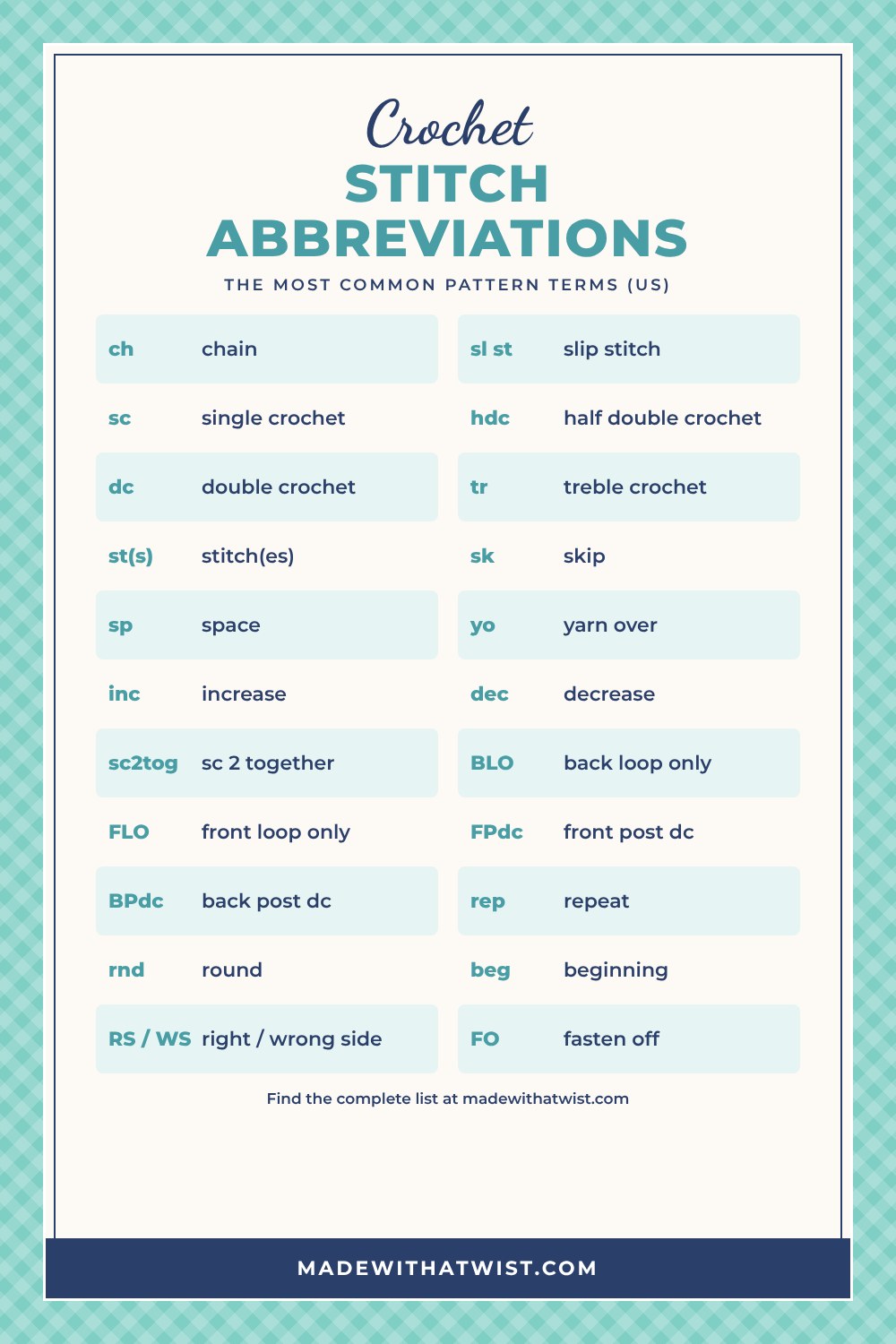
Want the written abbreviations for these stitches? They’re all on my crochet abbreviations list.
How to tell symbols apart at a glance
Once you notice the patterns in how symbols are drawn, you can figure out most stitches even before you check the key:
- Height = stitch height. A slip stitch is a tiny dot, single crochet is short, and each taller stitch gets a taller symbol. The symbols even line up with the height of the row.
- Count the slashes to count the yarn overs. No slash is a half double crochet, one slash is a double crochet (yarn over once), two slashes is a treble (yarn over twice), three is a double treble.
- Joined at the top = a decrease. When two or three stitches lean in and meet at the top, they’re worked together (sc2tog, dc3tog).
- Joined at the bottom = an increase or shell. Stitches fanning out from one point are all worked into the same stitch or space.
- Joined at top and bottom = a cluster, puff or popcorn. All the stitches go into one spot and close together into one.
- A hook at the bottom = a post stitch. The direction of the hook tells you front post or back post.
How to read a crochet chart worked in rows
Here’s a tiny chart: a foundation chain, one row of single crochet and one row of double crochet.
- Start at the bottom with the foundation chain and work your way up.
- Find the row number. It sits at the end where that row begins. Odd rows (right-side rows) usually start on the right and are read right to left.
- Turn and read the next row the other way. Even rows (wrong-side rows) start on the left and are read left to right.
- Turning chains are drawn at the start of each row, stacked up like a little tower of ovals. In the example, the chain 3 at the start of row 2 counts as the first double crochet.
- Each symbol sits on top of the stitch it’s worked into. If a symbol’s base points to a space between stitches, you work into the space.
How to read a crochet chart worked in rounds
Round charts (for granny squares, doilies, mandalas and hats worked from the top) start in the middle and grow outward.
- Start at the center. You’ll usually see a ring of chain ovals or a magic ring.
- Look for the round number next to the beginning of each round. Each round often starts with a stack of turning chains.
- Read counterclockwise if you crochet right-handed. You work around without turning, so the right side is always facing you.
- The slip stitch dot at the end of a round shows where you join to the top of the first stitch.
- Colors usually change round by round. Many designers draw each round in a different color, or alternate black and color, just to make it easier to see where one round ends and the next begins. It doesn’t always mean you should change yarn color.
Left-handed? Read rows left to right on right-side rows, and read rounds clockwise. Some lefties find it easier to flip the chart in a photo app or on a copier so it matches the direction they work.
Tips for reading crochet charts
- Print it big. Enlarge the chart so the symbols are easy to see, especially the slashes.
- Mark your place. Use a highlighter or a sticky note under the row you’re working on, and move it up as you go.
- Read it alongside the written pattern. If your pattern has both, the written instructions and the chart explain each other. This is one of the fastest ways to learn.
- Count the symbols, not just the shape. A quick count of the stitches in each row or round helps you catch mistakes early.
- Check the key every time. Most symbols are standard, but special stitches and the single crochet symbol (+ or X) vary from designer to designer.
Crochet chart FAQ
Is single crochet an X or a plus sign?
Both! The Craft Yarn Council lists both + and X as standard symbols for single crochet. A designer will use one or the other throughout a pattern, and the key will tell you which.
Do all designers use the same crochet symbols?
Most use the standard symbols, especially for basic stitches. Special stitches are where you’ll see variations, so always check the key.
Why do some patterns use charts instead of words?
Charts show you what the finished stitches look like and how they fit together, which written instructions can’t do. They also work in any language, which is why charts are so common in Japanese and European patterns.
Are crochet charts in US or UK terms?
Neither! The symbols are the same no matter which terms a pattern uses. A T with one slash is always the stitch American patterns call double crochet (UK treble). The key will name the stitches in the designer’s terms.
Is it easier to read a chart or a written pattern?
It depends on how your brain works. Visual learners often find charts easier, especially for lace and motifs. If charts are new to you, start with a pattern that has both.
Keep learning
- Crochet Abbreviations: Complete List for Beginners (US Terms)
- Crochet Hook Size Chart: Metric, US and UK Conversions
- Crochet Yarn Weight Chart: Every Yarn Weight Explained
- How to Crochet a Chain (and Count Your Foundation Chain)
- Crochet Skill Levels Explained: Beginner to Experienced